
Will the New Dietary Guidelines Actually Make Americans Healthy?
Written by Emily Banser, RDN
The release of new Dietary Guidelines has ushered in a wave of news headlines, social media posts, and hot-takes all focused on what Americans are “supposed” to be eating. While these new Guidelines have been framed as a major shift in how we should eat, the reality is that the Guidelines contain most of the same well-worn nutrition advice you’ve been hearing for years. What does reflect a major– and backwards– shift is the language, tone, and visual presentation chosen by this administration, choices which reinforce food moralization and diet culture, without offering clear or practical guidance. Read on for our team’s thoughts on the latest recommendations and reach out to schedule an appointment with your RDN if you’re not certain how (or if!) these guidelines apply to you. We now offer coaching sessions (which do not require a medical or nutrition diagnosis) with our skilled RDN, Briana!

What are the Dietary Guidelines?
Since 1980, the United States Department of Agriculture (USDA) and the Department of Health and Human Services (HHS) have collaborated on dietary guidelines which inform nutrition policy across a range of government services - school lunch programs, food assistance programs like SNAP or WIC, and more. These guidelines are reviewed and updated every five years, so depending on your age, you may remember past versions like The Food Pyramid or Choose My Plate, which debuted in 2011. There is also a reasonable chance that you’ve never heard of either of these - and that’s okay too! The Dietary Guidelines are not individualized recommendations nor a mandatory pattern of eating.
The new Guidelines, released on January 7, 2026, contain some familiar language; fruits and vegetables are still encouraged, whole grains still matter, alcohol is something to limit. Despite political framing, the core nutrition messages in the 2025-2030 Dietary Guidelines are largely unchanged from prior editions. Though, speaking of language, the new Guidelines open with a “simple message” to “eat real food.” There has never been an official definition of “real food,” and this phrasing introduces more confusion and fear than clarity. Furthermore, nutrition guidance has never and will never be “simple.” At the Yellow House Project, we believe there are many factors involved in making food decisions and do not shame anyone for their dietary choices. We help our clients choose foods that are right for them, with consideration of their preferences, financial means, schedule, cooking skills, and health history - an often complicated web of many moving parts!
The letter also erroneously blames individual dietary choices for the “health crisis” in America. Of course we as Registered Dietitians recognize the benefits of a healthy diet, but to position diet alone as both the root cause and the front-line cure to chronic disease is to miss the bigger picture. Health is multifactorial and strongly influenced by genetics, lived environment, socio-economic and educational status, and –at times-- luck. Framing diet as the primary driver of chronic disease shames the individual and ignores the complex systems that shape health outcomes for everyone. It’s a diet-culture cop-out.
What is being recommended?

The Guidelines outline 8 specific recommendations.
1. Eat the right amount for you.
Even with a shift from more neutral language, this concept remains especially important in a world run amok with diet-culture, which often promotes low calorie dieting and other forms of restrictive eating. Some signs you are eating an appropriate amount of calories include: sleeping well and feeling energized for your day, noticing regular appetite cues (hunger and fullness) which align with regular meals and snacks, and being able to approach food with flexibility, not rigidity.
2. Prioritize protein at every meal.
An odd recommendation to highlight, as Americans already tend to over-consume protein, especially protein from animal sources and fortified foods like protein bars, protein pancakes, even protein coffee! While high protein consumption itself is not likely to be harmful for the average person, this can contribute to imbalanced intake by driving up saturated fat intake (present in red meat and other animal products) and displacing sufficient carbohydrate and fiber intake. Instead, The Center For Science in The Public Interest (CSPI,) which has published The Uncompromised Dietary Guidelines for Americans 2025-2030, suggest to, “customize and enjoy nutrient-dense food and beverage choices to reflect personal preferences, cultural traditions, and budgetary considerations...” and go on to define nutrient dense foods as: “foods [which] provide vitamins, minerals, and other health-promoting components and have no or little added sugars, saturated fat, and sodium.” The science here has not changed, just the messaging.
3. Consume dairy.
Dairy (and soy or other dairy alternative) products contain protein, calcium, and other vitamins and minerals. This recommendation fits squarely with past iterations of the Dietary guidelines.
4. Eat vegetables and fruits throughout the day.
Again, nothing new here! Encouragement to eat more fruits and vegetables has been a staple of the Dietary Guidelines and nutrition education for years.
5. Incorporate healthy fats.
Fat is a necessary component of a healthy diet that is classified as either saturated fat or unsaturated fat. Generally speaking, we should aim to consume mostly unsaturated fats from plant-based sources, such as nuts, whole grains, vegetables, and vegetable oils higher in unsaturated fat, such as olive, soybean, corn, safflower, and sunflower oils. Meat, other animal products, and fried foods tend to contain more saturated fat, which research still suggests should be limited.
6. Focus on whole grains.
Grains are an important source of carbohydrates as well as many key vitamins and minerals. Whole grains, as opposed to refined grains like breads, pastas, tortillas, and chips made with refined flour, will contribute more vitamins, minerals, and fiber to the diet.
7. Limit highly processed foods, refined carbohydrates, and added sugars.
A focus on increasing dietary variety by including nutrient-dense foods is likely more beneficial to health than restricting or limiting foods that are highly processed or contain significant added sugars, especially given how prevalent these foods are in our food supply. Imposing strict rules about allowable foods may increase the desirability of these already highly palatable (i.e., yummy!) options and contribute to, or even cause, disordered eating patterns. There is also ongoing debate about how “highly processed” foods are defined, and a broad approach to limiting them may unintentionally eliminate an important source of calories and fortified nutrients for some individuals. Rather than representing innovation, this reflects a continuation of past recommendations with a more controlling spin.
8. Limit alcohol.
For adults of legal drinking age, it is not recommended to begin consuming or increase consumption of alcohol to promote health, and, generally speaking, drinking less alcohol is healthier than drinking more. People who should completely avoid alcohol include: children and teens, pregnant women, people who are recovering from alcohol use disorder or are unable to control the amount they drink, and people taking medications or with medical conditions that can interact with alcohol. Speak with your doctor if you take medication and are unsure if there could be an adverse interaction with alcohol.
The New Food Pyramid
The visual representation of the Guidelines, which often reaches far more people than the written directives, is depicted as an inverted pyramid. This format suggests a hierarchy where none exists, placing some foods “above” others in terms of health benefits. Oddly, protein appears at the top alongside fruits and vegetables, with fats floating in the middle, sending mixed messages about which food groups to prioritize and offering little clarity about reasonable portion sizes.
The represented foods also clash with the recommendations from nutrition experts, heavily featuring animal based proteins: steak, chicken, salmon and eggs. When it comes to protein, research suggests most people should increase intake of beans, peas, lentils, nuts, seeds, and soy products (featured minimally if at all on the new food pyramid) and decrease intake of red and processed meat to meet protein and underconsumed nutrient needs, like fiber.
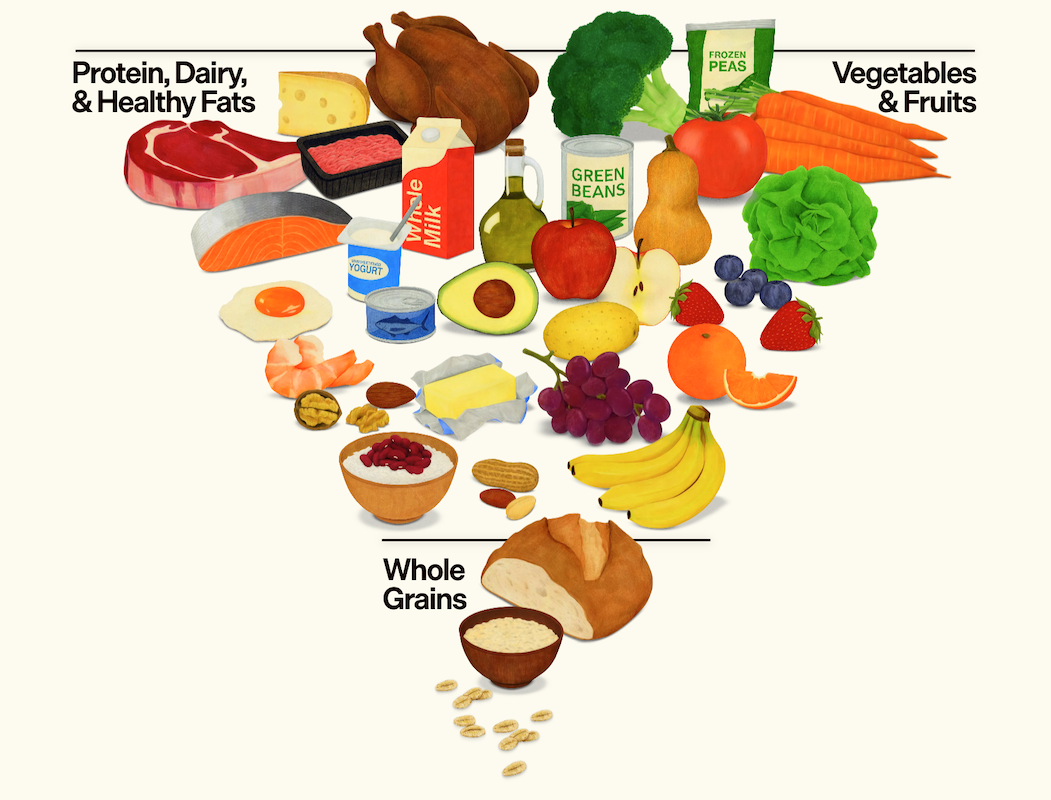
Source: https://realfood.gov/
And finally, the representation of individual, mostly raw, foods gives virtually no guidance on how to combine these ingredients to prepare balanced meals. At the Yellow House Project, we take a much broader approach to health and wellness than narrowly focusing on individual food choices. We believe a healthy diet consists of regular, accessible meals made from foods that are both pleasurable and nourishing (the food choices are up to you!) and that a healthy diet is only one small part of your overall wellbeing.
Ultimately, the Dietary Guidelines are just that - guidelines. They are not a prescription, a measure of virtue, a test on whether you are doing nutrition “right” or a guarantee of positive health outcomes. In the case of the 2025-2030 Dietary Guidelines, they are not really anything new, either.
Health is shaped by far more than individual food choices, and a nourishing diet looks different depending on your body, culture, access, preferences, and life circumstances.
At The Yellow House Project, we focus on supporting regular, satisfying meals that are both pleasurable and nourishing, without food rules or hierarchy. If you’re feeling confused, pressured, or disconnected from eating because of nutrition messaging, you are not alone - and you don't have to navigate it by yourself!